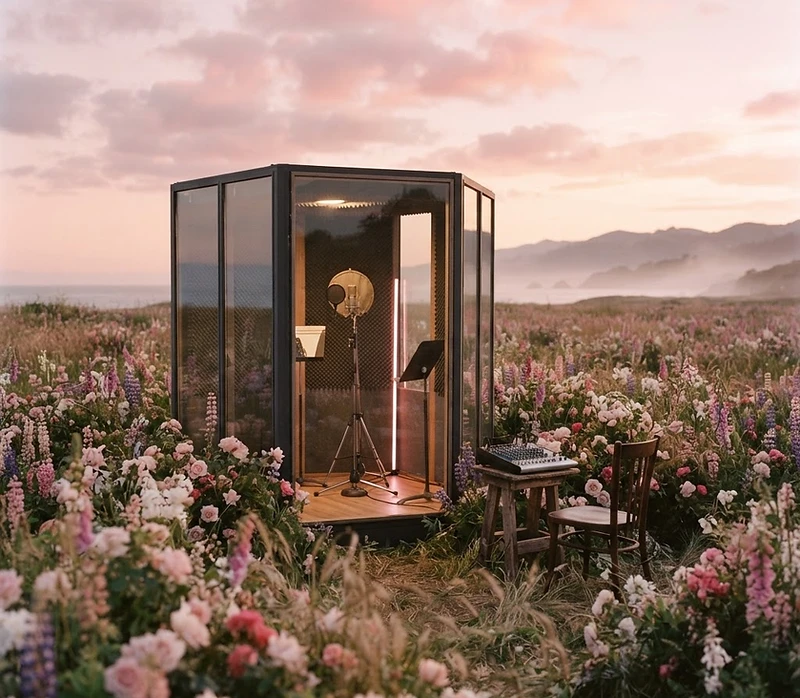
The Music Issue · Choose Life
They chose
the music.
Inside the unlikely creative chemistry of Kaya Jones and Housenatic—and the long nights, house-music obsession and Las Vegas sessions that became Choose Life.
Kaya Jones & Housenatic · 13 tracks · Shiloah Records · 2026
There are albums that begin with a meeting.
Others begin with a melody, a lyric scribbled into a phone, a piano progression or an expensive studio session booked months in advance.
Choose Life began differently.
It began with sound.
Before Kaya Jones entered the recording booth, before the words existed, before anyone could know exactly what the project would become, producer Housenatic—known to those around him as Sunny—was building worlds out of rhythm.
House music was not simply a genre reference for him. It was a language he had absorbed over years of listening: the repetition that becomes hypnotic, the tension between percussion and space, the moment a bass line changes the energy of an entire room.
He pulled from the records, artists, eras and sounds he loved, not to imitate them, but to understand what had always moved him about them.
Then he started building.
Beat after beat.
Idea after idea.
Somewhere inside those productions was the beginning of Choose Life.
And then Kaya Jones heard them.
What happened next would eventually become a 13-song album stretching nearly an hour—a project where electronic music, Afro-house textures, pop instinct, spirituality, vulnerability and the simple physical pleasure of dancing began occupying the same space.
But before any of that, there was work.
A lot of it.
01
The Architect and the Storyteller
“Housenatic could make the body move. Kaya wanted to give that movement a reason.”
Talking with Jones and Housenatic about the record, one detail becomes immediately clear: neither describes Choose Life as the product of a conventional studio assembly line.
Their roles were distinct, but deeply connected.
Housenatic created the musical architecture.
Kaya stepped inside it.
Sunny describes his process as instinctive. His productions draw from the many corners of house music that have stayed with him—the rhythms, records and musical influences he genuinely loves.
He was not starting with a marketing category.
He was following feeling.
“I love house music,” is essentially where the explanation begins.
That simplicity matters.
Because the album's production does not sound as if someone sat down and decided what box it needed to fit into first. It feels more like a producer following his ear until he finds something that creates a physical response.
A pulse.
A lift.
A reason to keep listening.
Then came Kaya.
She flew to Las Vegas and went to work.
Not casually.
Not for a few glamorous studio photographs and a vocal session squeezed between meetings.
Hours became long sessions. Lyrics were written and rewritten. Vocals were recorded. Ideas were pushed further.
The beats Sunny had constructed became environments in which Kaya could start asking a different question:
What does this music want to say?
That distinction sits at the heart of their collaboration.
Housenatic could make the body move.
Kaya wanted to give that movement a reason.
02
Las Vegas, After Hours
There is something fitting about Choose Life taking shape in Las Vegas.
Few cities understand the relationship between sound, spectacle and human emotion quite like it.
At night, Las Vegas is practically engineered around sensory experience—light, bass, movement, fantasy, repetition, anticipation.
But behind the spectacle, Jones was doing something considerably less glamorous.
She was working.
Writing for hours.
Recording.
Listening again.
Changing things.
Going back into the booth.
Following an idea until it became a song.
The process stands in contrast to the speed at which music is often consumed now. A listener can skip a track in seconds. An artist can release a song into an endless feed and watch it disappear almost immediately beneath the next thing.
Choose Life required the opposite mentality.
Stay with it.
Go deeper.
Keep working.
That persistence can be heard in the scale of the finished record. Across thirteen tracks, the project moves through songs including “Genesis,” “MAMA,” “Holy,” “Lions & Lambs,” “Fire By Night,” “Running With Angels,” “HISTORY,” “Dark To Light,” “Mahaba” and its title track.
The names alone suggest something larger than a collection of club records.
There is birth.
There is family.
There is darkness.
There is light.
There are questions of history, belief and transformation.
And underneath them is a beat that keeps moving forward.
03
When a Beat Becomes a Song
“Two people making something neither would have made independently.”
Producer-and-vocalist collaborations can sometimes feel transactional.
A beat arrives.
A singer records over it.
A file gets sent back.
Release.
This does not appear to have been that.
What becomes interesting in talking to Jones and Housenatic is the exchange between their creative instincts.
Sunny's productions gave Kaya somewhere unexpected to go.
Kaya's writing gave the productions another dimension.
One built the landscape.
The other began populating it with memories, convictions, questions and hooks.
Then each reacted to the other.
That is collaboration at its most productive: not two people protecting separate territories, but two people making something neither would have made independently.
For Housenatic, the pride comes from hearing those productions become a complete body of work.
For Jones, it comes from knowing what happened between the first playback and the final recording—the hours most listeners will never see.
And when they speak about the finished music, there is a noticeable absence of apology.
They are proud of it.
Not because creating an album guarantees attention.
Not because a release automatically becomes a moment.
They are proud because they know what it required.
04
Inside the Songs
“We are living on His Story.”
Not every song began the same way.
Sometimes Sunny’s beat came first.
Sometimes the lyrics came first, and the music had to rise up to meet them.
“Genesis” is written from the perspective of Eve, the first woman, as she exists in Kaya’s creative imagination.
It isn’t a history lesson. It’s a beginning, imagined from the inside: waking up to a world that is brand new.
“HISTORY” is a play on words.
History. His Story.
We are living on His story, Kaya says, and that idea drove her through the writing.
“Holy” is about coming to God.
It’s not a performance of faith. It’s the act of walking toward it.
Taken together, the songs follow a path from the first morning to a conversation with God, carried the whole way by a beat that won’t let anyone sit still.
05
Choosing to Continue
“She chose to keep going.”
Choose Life was not easy to make.
Kaya went through a lot while she was writing it.
She came close to losing her brother.
She went through hard times and a heartbreak.
At any of those points, putting the album aside would have been understandable.
She chose to keep going.
That choice is the whole record in miniature.
Kaya doesn’t want to dwell on the hard parts.
She wants to focus on the good, spread a good message, and bring everyone along with her.
06
Kaya Jones Has Nothing Left to Prove—Which May Be Why She Sounds Free
“Meaning does not require stillness. Sometimes it needs a kick drum.”
Jones has lived several lives in public.
Her name first reached mass audiences through the Pussycat Dolls. Her career afterward moved through solo pop, performance, gospel-rooted work, advocacy and independent music.
She is also a featured vocalist on “Let It Be Love,” from Jason Crabb's Unexpected, the album that won the 2019 GRAMMY Award for Best Roots Gospel Album.
But using those chapters merely to introduce her now misses what is happening.
Choose Life does not sound interested in nostalgia.
Jones seems considerably more interested in creation than recollection.
That may be one reason the Housenatic partnership works.
Sunny did not need to recreate a previous Kaya Jones record.
He gave her another environment entirely.
And Kaya did not approach the material as though she needed to reproduce an earlier version of herself.
She wrote toward the person she is now.
The result sits somewhere between dance record and personal declaration.
It asks listeners to move without requiring them to leave meaning at the door.
That balance has become central to this era of Jones' work: music can carry conviction without becoming musically restrained. Electronic production can hold spiritual questions. A dance floor can contain joy, grief, gratitude and belief simultaneously.
Meaning does not require stillness.
Sometimes it needs a kick drum.
07
“Choose Life” Without Standing Still
The album's title could easily have produced a heavy record.
Instead, Jones and Housenatic moved in the opposite direction.
There is celebration here.
Movement.
Release.
That choice is significant.
The title came from looking inward.
Choose life. Choose love, so we can love one another. Choose good. Choose living.
Jones has publicly described the project in terms of choosing goodness, choosing the people around you and making the decision each day to become better. But musically, that philosophy is delivered through rhythm.
The message does not sit above the music.
It rides inside it.
And perhaps that is one of the more interesting things about what Jones and Housenatic have created together.
They understand that listeners do not always want to be lectured.
Sometimes they want to feel something first.
A great beat gets through the door before an argument ever could.
A melody stays after a conversation ends.
A lyric can mean something entirely different when hundreds of strangers sing it together.
House music has always understood the communal power of repetition—the strange transformation that occurs when individual people enter the same rhythm.
Choose Life takes that instinct and asks what else might be carried inside it.
Hope, perhaps.
Forgiveness.
Faith.
Memory.
Love.
08
The Moment After the Album
Now comes the part artists cannot fully engineer.
The record is finished.
It belongs to listeners.
And attention around Jones and Housenatic is beginning to move beyond the mechanics of simply releasing music.
Kaya's current official world presents Choose Life not as an isolated album but as part of a broader creative chapter—visual storytelling, performance, new media and the philosophy she continues to place at the center of it:
Lve Everyone Unconditionally.
Importantly, that phrase and Choose Life are not the same thing.
Choose Life is the album.
Love is the larger idea Kaya intends to carry beyond it.
For Housenatic, the record introduces audiences to a producer whose identity begins with the thing that started this entire process: his obsession with sound.
The next question is not whether these two can make a record together.
They already answered that.
The question is how far the world they discovered together can expand.
09
Two People. Two Processes. One Record.
Ask artists what they are proudest of and the answer is often some variation of the finished product.
With Jones and Housenatic, the more compelling answer may be the process itself.
A producer followed the music he loved.
A singer heard possibility inside it.
She got on a plane.
She went to Las Vegas.
She wrote.
She recorded.
They kept building.
And eventually, the individual pieces stopped sounding like experiments and started sounding like an album.
There is a tendency, particularly when attention begins growing around a project, to rewrite creativity as inevitability.
It was always going to work.
The collaboration was obvious.
The album was destined to exist.
But that is rarely how creation actually happens.
There is a moment before the finished record when nobody knows.
Only the people in the room.
Only the next beat.
The next lyric.
The next take.
The decision to keep going.
That uncertainty is where Choose Life becomes most interesting.
Because despite the scale of the ideas surrounding it, this record ultimately comes down to something remarkably human:
One person made something that moved him.
Another person heard it and felt she had something to say.
Together, they kept going until the music said it.
And now they can finally step away from the studio long enough to be proud of what they made.
Quick take
Kaya + Housenatic
When did you realize this was becoming an album rather than a collection of songs?
Kaya:There was a point where the songs started speaking to one another. It wasn’t simply, “Here is another track.” We were creating a body of work. Once I felt that, I became even more focused because I knew there was a story forming.
Housenatic:For me, it started with making music that I genuinely wanted to hear. I was pulling from house music and all these influences I’ve loved for years. Then Kaya would take something and bring an entirely different emotion into it. That’s when it started feeling bigger.
Sunny, where does a Housenatic track normally begin?
Housenatic:Feeling. Always. It can be percussion, a bass line, a texture—something that makes me react. I have so many influences from house music because I genuinely love the genre. I don’t want to copy a particular record. I want to understand what makes that feeling work and then build my own version of that energy.
Kaya, what happened when you arrived in Las Vegas?
Kaya:Work. [Laughs.] A lot of work. I spent hours writing and recording. When something is important to me, I can become completely consumed by it. I wanted every song to have a reason to be there. Sunny gave me these incredible musical environments, and my job was to find the story living inside them.
Did you challenge each other creatively?
Kaya:Absolutely. That’s what you want. The best collaborator isn’t someone who simply agrees with everything you do. It’s someone whose work makes you think differently.
Housenatic:And you have to trust each other enough to let the song change. Sometimes what you imagined at the beginning isn’t what it wants to become.
What are you most proud of when you hear the album now?
Housenatic:That it sounds like us. You can hear the influences, obviously, because everybody has influences. But the finished record has its own identity.
Kaya:I’m proud that we finished what we started. People hear fifty-five minutes of music. We hear everything behind those fifty-five minutes. The hours, the writing, the conversations, the takes that didn’t work, the ones that suddenly did. I hear the journey.
And what do you want people to feel when they hear it?
Kaya:Alive.

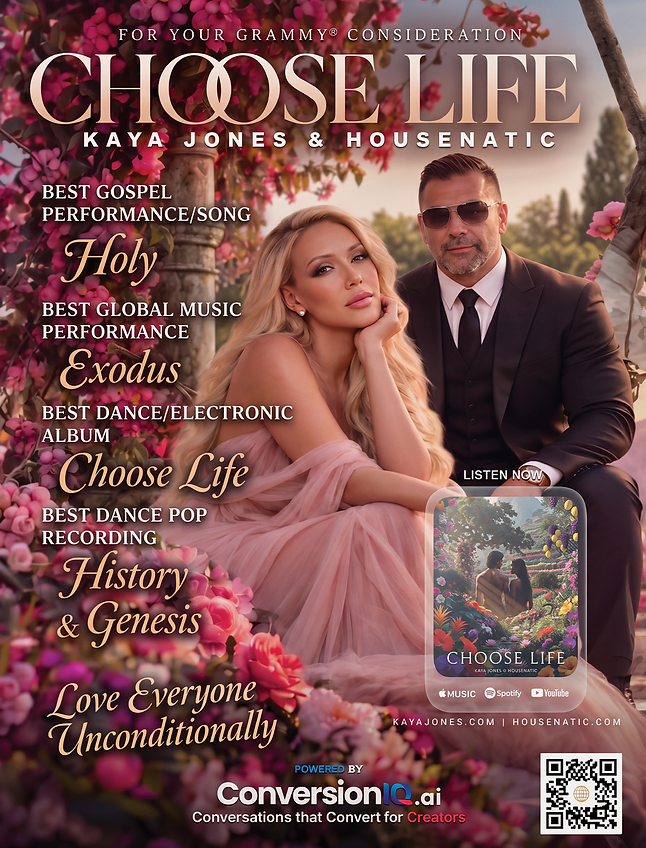
Kaya Jones & Housenatic
Choose Life
13 tracks · Shiloah Records · 2026
Choose Life is the album.
Lve Everyone Unconditionally is the message.
Keep reading
More from Kaya


The Awards Issue
From “Genesis” to “Holy”: The Expanding World of Choose Life
Read the story

The Cover Story
Kaya Jones Is Choosing What Comes Next
Read the story

Feature · Human Race Records
Kaya Jones Opens the Door to Help Shape Music’s Next Generation
Read the story

The Interview
A New Chapter: Kaya Jones Steps Into Acting With a Holiday Film
Read the story

The Business Issue